What the Industry Won't Tell You
Every bag of landscape fabric sold in Salt Lake City says 'weed barrier.' It should say polypropylene. Here's what actually happens when you install it.
April 9, 2026
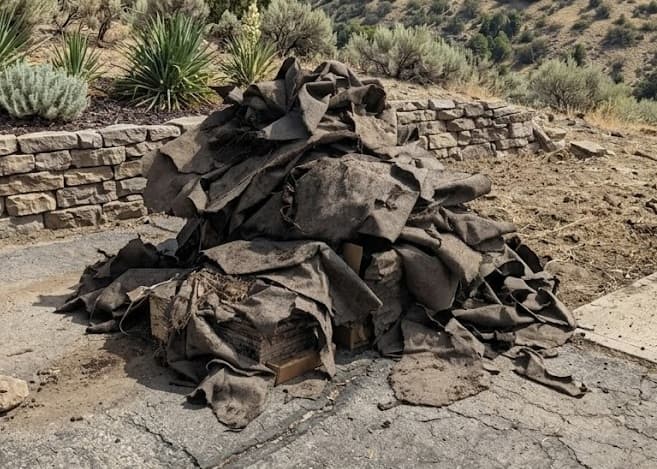
Walk into any hardware store in Salt Lake City and you'll find bags labeled "professional landscape fabric," "weed barrier," and in some cases, "eco-friendly weed control." The bags are green. Sometimes they have a leaf on them.
The material inside is polypropylene.
Polypropylene is a petroleum-based thermoplastic. It is the same polymer used in disposable surgical masks, plastic bottle caps, and single-use food containers. When the landscaping industry calls it a "weed barrier," they are technically correct. What they do not tell you is what it does to the ground beneath it.
The sales pitch is that landscape fabric suppresses weeds while allowing water and air to pass through. In a freshly installed yard, this is partially true. Within one to three growing seasons, it is no longer true of either claim.
Organic matter — decomposing leaves, soil amendments, mulch — settles on top of the fabric and creates a perfect germination bed for weeds, including the ones the fabric was supposed to stop. Meanwhile, roots from established plants push through the fabric from below, anchoring it to the soil in a way that makes removal a multi-year excavation project.
More importantly: the fabric cuts off the exchange between the surface and the living soil biology beneath it. Earthworms, fungal networks, and decomposer communities depend on the physical connection between the surface organic layer and the mineral soil below. Landscape fabric ends that connection.
Most plants form partnerships with mycorrhizal fungi — networks of fungal threads that extend a plant's root system, trading soil minerals for carbon. These networks are how native plant communities communicate resource availability, share water during drought, and establish the soil biology that makes a landscape self-sustaining.
Mycorrhizal networks require undisturbed soil to persist. They are disrupted by tillage, by synthetic chemicals, and by barriers that prevent colonization of new organic matter from above. Landscape fabric installed over native soil is not neutral — it actively severs the vertical ecology that makes that soil alive.
A landscape installed over fabric may look established. The soil beneath it is not.
Utah has approximately 930 native bee species. This is not a marketing claim — it is documented by Utah State University's Bee Lab, which maintains one of the most comprehensive wild bee databases in the country.
Approximately 70% of North America's native bee species are ground-nesting. They require exposed or lightly mulched bare soil to complete their life cycle. They cannot nest through polypropylene sheeting.
This matters in Salt Lake City because SLC's east side sits at the ecotone between foothill sagebrush communities and urban development — one of the higher-diversity native bee habitats in the Wasatch Front. A landscape fabric install in the Avenues does not happen in an ecological vacuum.
Jordan Valley Water Conservancy District, which manages water for most of SLC's east side, spent three years removing landscape fabric from their Conservation Garden Park in West Jordan. Their reason was the same: fabric destroys the soil biology and native bee habitat that a functioning native landscape depends on.
JVWCD no longer allows landscape fabric on projects that receive their lawn replacement rebate. This is the district that offers $3.00 per square foot for lawn-to-habitat conversions in SLC. They removed it from eligibility because they saw the damage firsthand.
Polypropylene does not biodegrade. It photodegrades — breaking down under UV exposure into progressively smaller fragments. In soil conditions, where UV exposure is limited, this process is slow. But it does happen.
Microplastic contamination in residential soils is a documented phenomenon. A 2020 study in Nature found that agricultural soils contain four to twenty-three times more microplastics than ocean surface water. Landscape fabric is one of the documented sources.
We don't know the full long-term consequences of microplastic accumulation in residential garden soils. What we know is that polypropylene fragments are persistent, that they accumulate in soil food webs, and that they have been found in earthworms, plants, and in the groundwater beneath treated areas.
The bags don't say any of this.
The function landscape fabric is supposed to serve — weed suppression during plant establishment — can be achieved with a 3–4 inch layer of coarse wood chip mulch. Unlike polypropylene, wood chips decompose into organic matter that feeds soil biology. They improve moisture retention. They create the irregular surface texture that ground-nesting bees require.
During the first growing season, when a native plant community is establishing, some weeding is required. This is true with or without fabric. The difference is that with fabric, you are managing weeds on top of a plastic sheet that is actively damaging the ecosystem beneath it. Without fabric, you are managing weeds in living soil that is building the biology your plant community needs.
The extra hour of weeding in year one is not nothing. It is significantly less consequential than removing several thousand square feet of anchored polypropylene from a mature planting bed — which is what JVWCD did, at significant cost, and what homeowners across SLC are now discovering they need to do.
We have never installed landscape fabric. We never will. This is not a preference. It is a position based on what we understand about soil biology, native bee ecology, and what the material actually does.
If your current yard has it, that is not an accusation. Most of the landscaping industry installed it for thirty years without examining the consequences. Now the data exists. Now you know.
If you're replacing a lawn in Salt Lake City and want an install built on real soil biology, that's what we do. See also: the 21 native species we use in SLC front yards.